

The Seat 850 Special was one of the most popular models on Spanish roads. We tell you its story on board this impeccably restored specimen.
Today we give ourselves a walk through history aboard this 1972 Seat 850 Special which is in a state of impeccable originality. This year the Seat 127 was also presented, the model that would end up completely replacing the Seat 850 as a medium utility vehicle in Spain and which represented such a huge leap in terms of conception that it caused our protagonist’s sales to plummet despite the price difference in your favor. With the Seat 127, rear-engine utilities completely disappeared from the map and all embraced the Mini’s technical scheme, with a transverse front engine (for better use of space) and front-wheel drive, which improved its active safety and behavior. Barely two years after enrolling our protagonist, the Seat 850 disappeared from the brand’s catalog in 1974.
We could say that the Seat 850 Special was the last “all back Spanish”although the Renault 8 would maintain this scheme until 1976 based on special series and retouching in the equipment in an attempt to stretch a gum that no longer gave more of itself, surpassed by the R-5 and R-7 and later for the Renault 9which could be considered his true successor.
Seat 850: a 600 in which the luggage did not smell of gasoline
The Seat 850 was born as the Fiat 850 in 1964 and it would take almost two years for it to be manufactured in Spain under license with the Seat brand. Although it lived with the Seat 600 until almost the end of its days (the 600 was discontinued in 1973 and the 850 only a year later), initially the 850 was born as a successor to its younger brother, but its price and size made that finally it was decided to keep both models in the catalog since there was an audience for both.
Sel Seat 850 grew just 27 centimeters compared to the 3.3 meters long that the 600 measured, but they made a big difference in terms of habitability. To start with on the 850 the gas tank was mounted in the rear, near the engine, instead of on the front hood.. This implied two enormous advantages for the “eight and a half”: it increased the capacity of the trunk and the luggage stopped smelling of gasoline. In the 600, spills when refueling were frequent and the vapors that ended up impregnating the luggage with their aroma were inevitable.
Also inside, the Seat 850 was more habitable than the six hundred and its 843 cm and 37 CV engine also marked a clear advantage for its older brother. In 1966, already being produced in Spain, the 4-door variant would arrive, which initially would have the same length as the 2-door model, but would end with a long wheelbase after just under 1,000 copies of the 4-door short chassis.
Seat 850 Special: the best seller
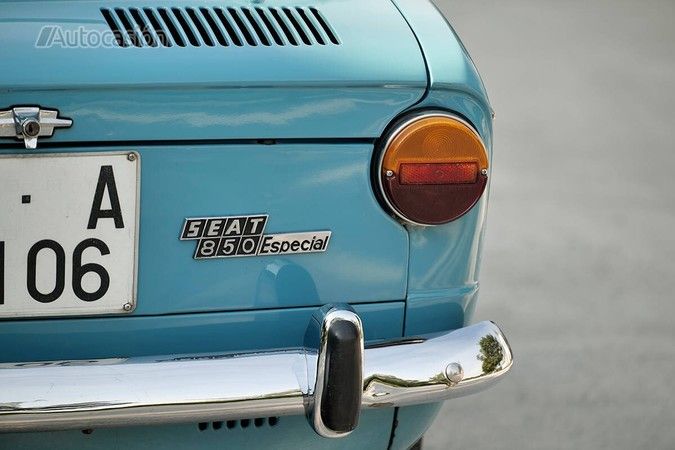
The Seat 850 Special was the most successful version within the range of eight and a half. The advertising at the time was very eloquent: “Load it to the brim, set it to over 140 and you’ll know why we call it Special.” This announcement would end up with its creators in jail today, but at the time it had the desired effect and made this version the most demanded by the public, who appreciated its extra power, an exterior more decorated with chrome side moldings and rims. specific, in addition to a more careful interior.
The engine kept the original 843 cm3, but based on a more generous carburetion and a somewhat braver distribution, it gained 10 CV that was outrageous, practically 30% more power. In this way, the Seat 850 Special announced a maximum speed of more than 140 km/h.
This increase in power implied other improvements, the most important being the brake discs on the front axle. To further improve its cooling, the rims of the 850 Special also grew and gained more ventilation holes than in the normal versions.
Inside, the main change was in the instrument panel, somewhat more complete, and in the decorations that identified this version.
Seat 850 Special: five seats… and some more
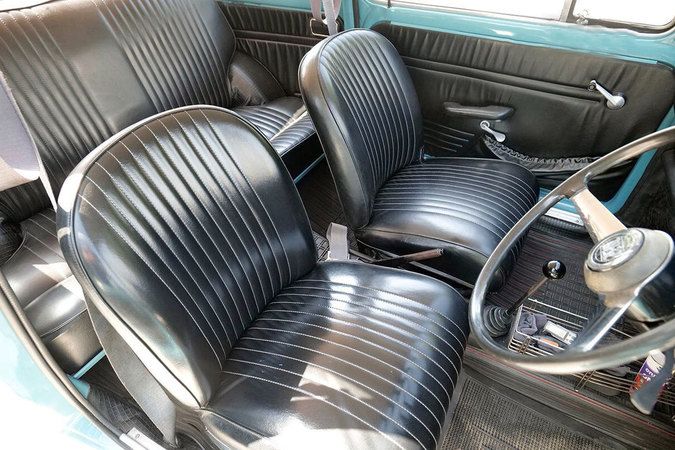
When you open the doors of the Seat 850 Special you find yourself with black skai seats that become frying pans in summer, but which despite their simplicity are comfortable. There is space for 5 people, although at the time trips with several more were frequent, considering that children occupied half a seat, so that up to 2 adults with 5 children could travel in it.
The pasta steering wheel is the same as that of the 850 Coupé, the same as the 47 CV engine that moves this small utility with great joy, in addition, with a very characteristic sound. This example has an instrument panel that was an accessory in its time, as well as the wire basket that goes next to the gear selector and that allows you to get something useful out of the center console to carry objects.
There are hardly any controls in a car that is very simple and in which there is almost no space to place a radio, which was another of the typical accessories of the time. The trunk in the front and the engine in the rear make it a very peculiar car that attracts attention today, but in its time it was very common and people were used to this type of distribution: Seat 600, Renault Dauphine and R-8, VW Beetle, Renault 4/4
Driving a Seat 850 Especial half a century later
Today it is hard to imagine that families would cross Spain in a car of this size, packed full of luggage and with the roof rack loaded to the brim, but that was the case. Taking a ride in it or using it in the city is a joy because it is small and ultra manageable, but five people plus luggage, in the summer in full traffic and without air conditioning, it had to be torture. Today I am not going on vacation to Torremolinos with the family but to take a walk around El Pedrido and the Betanzos estuary, along some little roads that seem to be made on the scale of 850 and in which I move as if they were a highway despite the fact that they barely reach 4 meters wide.
The truth is that it is a joy to drive these light cars, they have a special agility, and their 47 CV, which seems ridiculous, the truth is that they move it very well. It is a very cheerful car and the engine likes to rev rather high, in the environment of 4,000 rpm. His sound is very characteristic and takes me back to a few years when it was very common to hear him on the streets when I was a child.
The gearbox has 4 gears and they are perfectly staggered so that the engine is always in the liveliest area and moves this “family” car with ease. The brakes do their job well, there isn’t much weight to stop either, but the discs on the front axle are appreciated, much more adjustable than the drum ones of the normal versions.
The steering is good and the front axle enters the curves well even though there is hardly any weight on it. You have to get used to entering holding back or even leaning on the brake so that you have more load in front, but without going too far to prevent the rear axle, with much more mass, from coming off the ground and we end up spinning. Also, these cars change the rear axle camber a lot and go from some negative camber at idle and loaded (to give it more stability and grip) to a steep positive camber when braking and the rear axle lifts off.
The truth is that with the power available it is much nobler than I expected and it is difficult to put ourselves in a difficult situation unless we do everything possible to achieve it. What I don’t want to imagine is driving a Abarth OT 2000 With this chassis in a coupe body and with 185 CV that according to the preparations could reach up to 231 CV… come on… a gun in the chest, as they say.
In 50 years, cars have improved tremendously in terms of safety and performance, but this Seat 850 Special more than covered the real needs of the time. It was a car with which people could travel freely, very cheap to maintain, with low consumption and simple repairs that anyone could do. Yes, now we travel safer, but less free and in cars where repairs are neither easy nor cheap to fix.