

It is a reality that charging infrastructure is insufficient still in many countries. There is talk that it is necessary to have 340,000 public chargers by the year 2030 and the reality is that we are very far away, since currently there are barely 12,000 chargers. In this way, all solutions are welcome and there are some that could revolutionize. An example are these chargers for electricians on the sidewalkswhich stand out for their integration and ease of access.
They have been developed by rheinmetall, a German company specialized in all kinds of solutions in the industry, which offers this solution as ideal for several reasons. The main one is that they integrate into the urban landscape almost invisibly and solving problems current systems thanks to the reduced space it occupies or the low cost of its installation. It could be something similar to the proposal for streetlight chargers that we saw a while ago and that is already available on some sites.
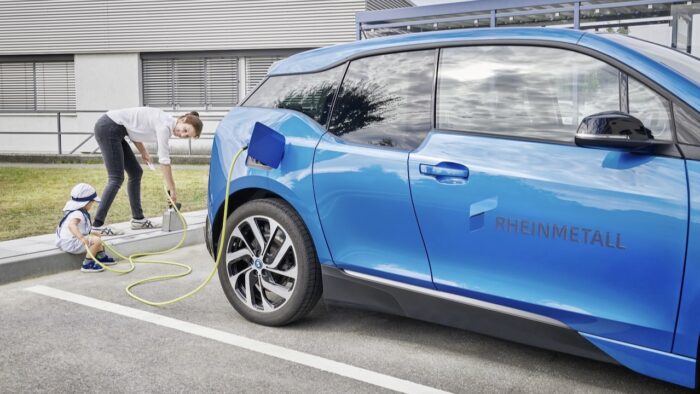
These chargers integrated into the curbs of the sidewalks have the premise of minimize intrusion into public space. In the cities and municipalities that install charging points, you have to deal with the size of traditional chargers, which is why it makes sense that they have proliferated in service stations or parking lots where there are not so many problems. But the truth is that many times they are further away from the city and they are not a viable solution. So Rheinmetall chargers want to be an alternative that can be integrated into Open Charge Point Protocols (OCPP).
They are not fast chargers like the DC ones you see elsewhere. They have a capacity of 22 kW in alternating current and they are completely modular. It consists of a fictitious curb that carries the entire recharging system and that It is very easy to install substituting it for the corresponding piece of sidewalk. They are prepared to withstand environmental conditions and also the passage of cars that can get on. These curbside chargers are undergoing extensive testing to see their long-term viability and the next phase includes a pilot project in Germany.