

Buick Motor Decision is the oldest American automaker. Its headquarters are in Flint. It is also a division of the General Motors concern.
The company’s history goes back to the last century, when Scottish-American industrialist David Buick got the idea to create an internal combustion engine. He decided to sell his stake to himself, owning a plumbing company on the basis of the right to jointly operate with a partner at that time. The proceeds from the sale were used to create a new company to implement their ideas. And in 1909 he founded the Buick Motor Car Company, which specialized in the production of power units for agricultural machinery.
In parallel with his colleague Marr, he worked on the development of internal combustion engines, and in 1901 the first successful project was invented in the form of a car, bought for $ 300 by a Buick acquaintance.
The development of the subsequent production put Buick in financial trouble and caused him to take out a loan from his colleague Briscoe, who made tools for the company. In response, Briscoe issued an ultimatum to Buick; accordingly, the latter had to reorganize the company, in which, on creditor terms, almost the entire block of shares belonged to Briscoe. Now Briscoe has taken over as manager and Buick has become his assistant.
In 1904, the company was sold to American industrialist Whiting, with Buick no longer serving as director.
In 1908, the automobile company became part of General Motor.
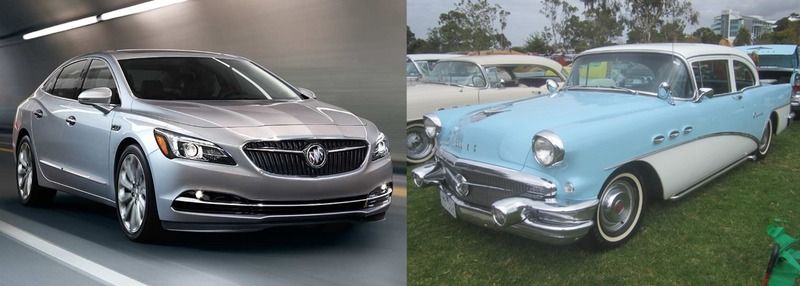
Production is focused on low-cost models of the same type of middle class cars.
EMBLEM
Since the founding of the company, the logo has been presented in a different variation over the years. Initially, the main feature of the badge was the Buick inscription, which over time changed the font and shape on which it was located, initially it was a rectangular shape and a circle, which was replaced by a background color scheme. Already in 1930, the number 8 was added to the article, which characterizes cars made on the basis of an 8-cylinder engine.
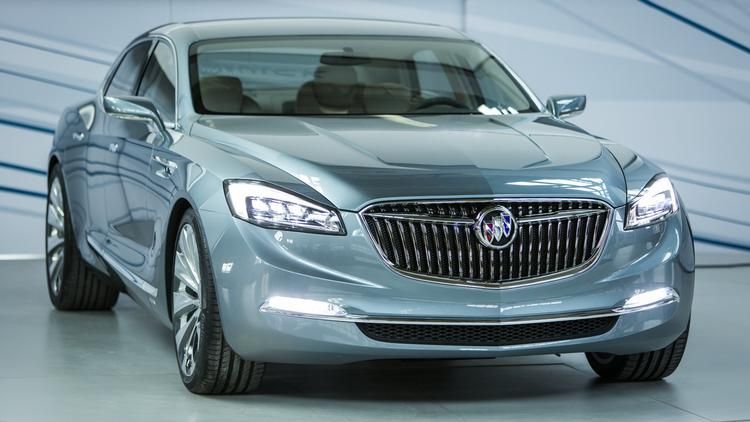
In addition, a massive reconfiguration of the emblem was carried out. Instead of an inscription, it now had the coat of arms of the glorious Buick family. After a while, with the advent of several car models, namely three, the coat of arms was multiplied in three and is now depicted on the radiator grille in the form of three folds of silver, placed in a metal circle. This emblem is used in modern times.
BUICK CAR HISTORY
In 1903, the first Buick car with a single-cylinder engine was introduced.
In 1904, the B model appeared, already equipped with a 2-cylinder power unit.
After joining General Motors in 1908, the Model 10 four-cylinder was produced. An upgraded version with a 6-cylinder power unit was released in 1914.
The 6 model with an open body and 25-cylinder power unit was launched in 1925.
Launched in 66, the 1934S featured a powerful 8-cylinder engine and independent front-wheel suspension.
The history of the Buick car brand
The first Roadmaster saw the world in 1936, and an upgraded version of the more powerful model appeared in 1948 and featured high technical performance.
The long model 39 90L was introduced in 1939. The main feature was the spacious interior that could accommodate 8 people.
In 1953, the Skylark was produced, equipped with a completely new V8 engine. Redesigned versions were introduced as compact models in 1979.
The famous Riviera made its debut with a coupe body, good technical performance and a powerful engine capable of reaching speeds of up to 196 km / h. The modernized version has greatly changed its appearance. The 1965 Riviera was characterized by a longer body, but also a volume and equipment with a powerful engine.
The history of the Buick car brandThe six-seater Regal began its history in the 70s. A car with a coupe body, two variants of the power unit were offered – V6 and V8. The Grand National model was modernized, it was a coupe-bodied sports car with a powerful engine capable of speeds up to 217 km / h.
The compact two-seater Reatta debuted in 1988 and I got into a new generation car. The car was equipped with front-wheel drive, and the power unit was located transversely, which made it more individual with a plus of external indicators.