

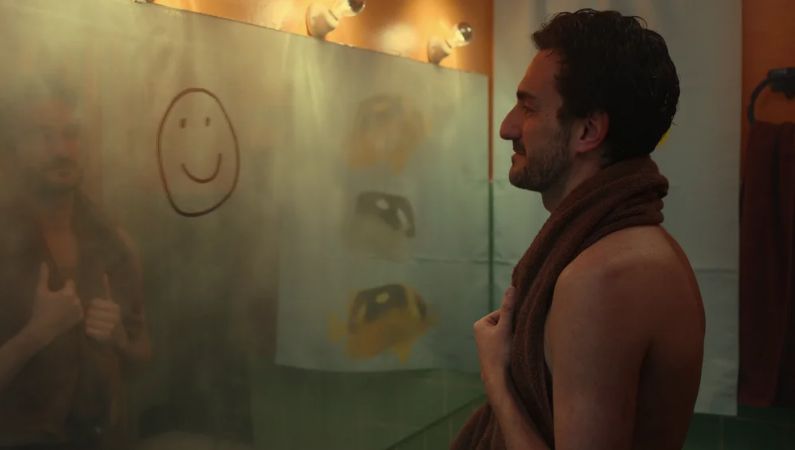
You just have to see the trailer for ‘Smiley’ to realize that Carlos Cuevas and Miki Esparbé have explosive chemistry between them. When they become Álex and Bruno this is final and, surely, one of the reasons that have made this LGTBI romantic comedy one of the three most sought after on Netflix since its premiere last week. But this, by itself, would not be enough. ‘Smiley’ also has some very well-spun dialogues that show, from minute one, the inner world of Álex and Bruno in a confrontation that is entertaining while helping to empathize with them.
kisses what do you think
More than one may be surprised getting excited when they kiss, because the way they do it is not the one we are used to when a gay character appears in a conventional series. Furthermore, in their tumultuous relationship nothing can be taken for granted and they always seem to do it as if it were some kind of mutual, irrational and passionate rescue, like life or death. The sexual orientation of the actors doesn’t matter, they just make you believe it and they do it with a style that will work with anyone who doesn’t live in the caves.
In addition, the sexual scenes are treated with a lot of sense to make the viewer move between the fiery and romanticism that governs the lives of the characters themselves. Sex is glimpsed, allowing us to sneak in just enough to understand the reactions and comments it generates in its protagonists. Perhaps this aspect of the show works especially well because of how it’s directed and the fact that the actors had intimacy coordinators who helped them avoid awkward situations and letting go.
the invisible line
That invisible line that seems to unite Álex and Bruno is a good resource to illustrate the importance of the dialogues in the series. Let’s go to the starting point. Álex works in a gay bar in Barcelona where, almost like an anachronistic fetish, there is a red telephone hanging on the wall. But it is not a mere decoration, but a real telephone that becomes the sound materialization of a magical link between people who, however different they may be, seem destined to meet. That is, in fact, what Bruno asks Álex when he tells him about an ancient Japanese story that ensures that there is an imaginary thread that unites the people who one day will have to meet.

He does so in a call that occurs in response to a message that Bruno has received by mistake when Álex dials the wrong phone number to put a previous couple back and a half. The brief conversation arouses in both the curiosity to know each other. The curious thing is that Álex’s message on the answering machine is a kind of monologue that, as a start to the series, is very interesting because, almost only with words, it makes it very clear where Álex comes from and why the meeting with Bruno, priori improbable, it makes perfect sense.

For his part, Bruno is a kind of cultured person who works as an architect who lives in an unreal apartment for these times and doesn’t eat a buck in dating apps. He is a lover of old movies, he loves romantic comedies and he looks for his partners in alternative environments because he believes that he will find people more similar to his tastes.

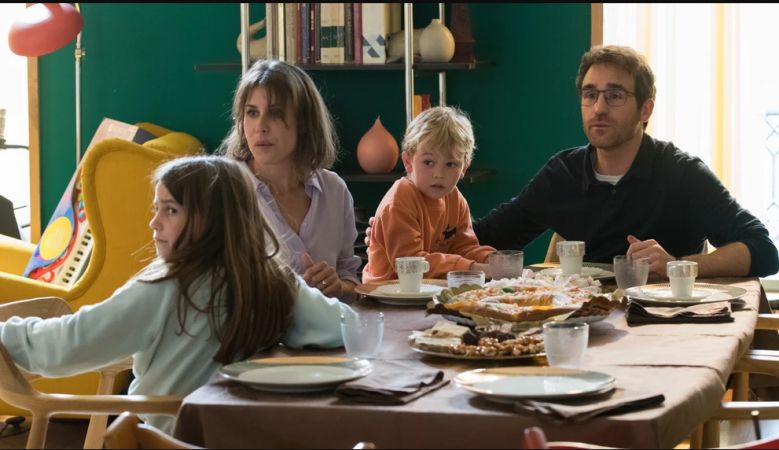
His reaction to Álex’s message is reproduced between his lonely house and his office, where he interacts with his friend Albert, the straight character played by Eduardo Lloveras who acts as his confidante as he faces the decline of his own marriage with the mother of his children who She is also the daughter of her boss. Seeing him comment on it and study if he should reply to Álex’s message, we will get to know Bruno and also the circumstances that will lead him to jump into the pool.
the secondaries
Added to this diverse portrait are the parallel stories of secondary characters that complement a universe that, essentially, exists to show us that there are thousands of different ways of loving. Javier, the excessive but endearing character of Pepón Nieto, embodies loneliness and the need to hide it by entertaining others.
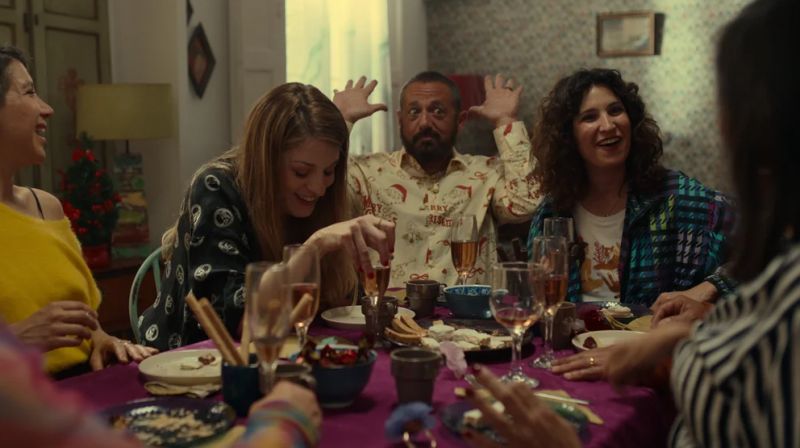
In Ramiro’s skin, Carles Sanjaime shows us a cowardice whose consequences, when it comes to love, time is incapable of mitigating. He will do it by returning to the life of Álex’s mother in an unexpected way. Albert also knows about cowardice, who has a frustrated vocation and his love does not seem capable of compensating for the troubles of an unsatisfied life. In fact, it is his wife Núria, played by Ruth Llopis, who could end up turning away from him if she wakes us up.
Ramón Pujol is the homonymous character who tries it with Bruno but whose crush on books is far from being able to compete with the hormonal chaos that Álex can generate in his partner with a simple look.

Patricia and Vero are the lesbians played by Giannina Fruttero and Meritxell Calvo, who, between decisions about what life they want to lead, will stumble about, ready to even fall into the temptation of opening the relationship.