

Manas Bhatia has a bold vision for the future, where residential skyscrapers are covered with trees, plants and moss that function as “air purification towers”. This would not only improve air quality, but also create a more aesthetically pleasing environment.
The New Delhi-based architect and computer designer, Arun Sarin, brought the idea to life in a series of detailed images. His imaginary buildings rise above a futuristic metropolis, while its curved forms are inspired by shapes found in nature.
But the pictures were not entirely from his own imagination.
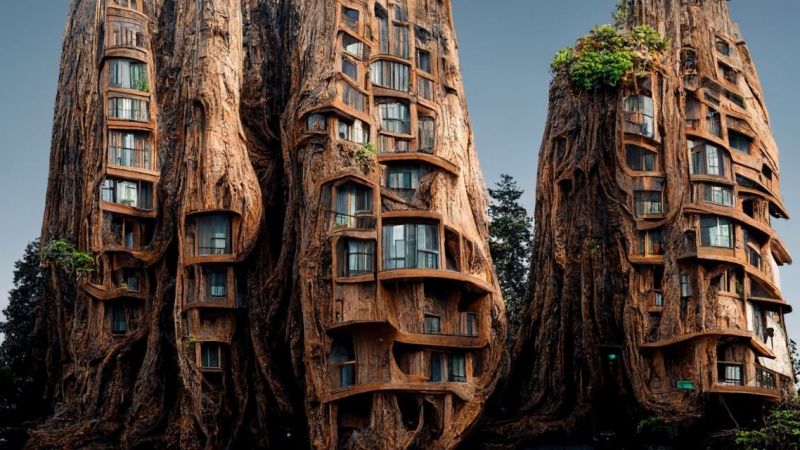
Bhatia used Midjourney, an artificial intelligence imaging tool, to create detailed images for her conceptual project “AI x Future Cities”. She provided Midjourney with a series of text descriptions with phrases such as “futuristic towers”, “utopian technology”, “symbiotic” and “bioluminescent material”. Midjourney generated a series of digital images that Bhatia further refined by sharpening the commands.
Bhatia said that the actual process of creating surreal art could take as little as 20 minutes. “The trial-and-error part is the most intense. You’re training the AI program and it’s learning and evolving over time.”
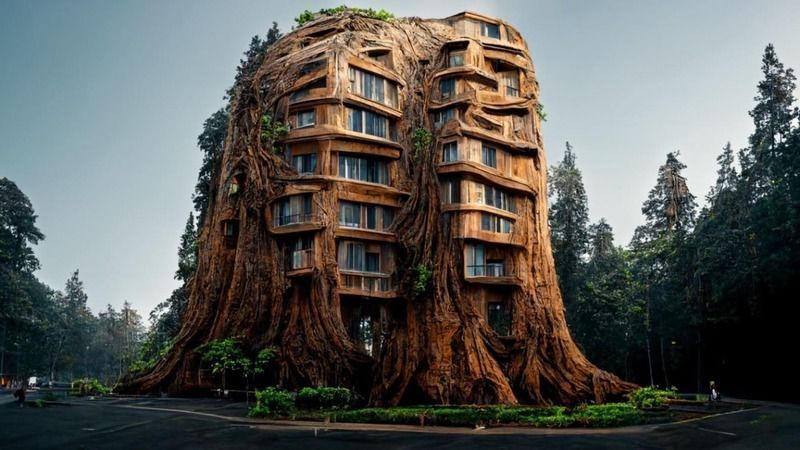
In another project called “Sim biological Architecture”, Bhatia imagined a utopian future in which giant circles would be built in small trees. These structures would be hollow and would be used for a variety of purposes.
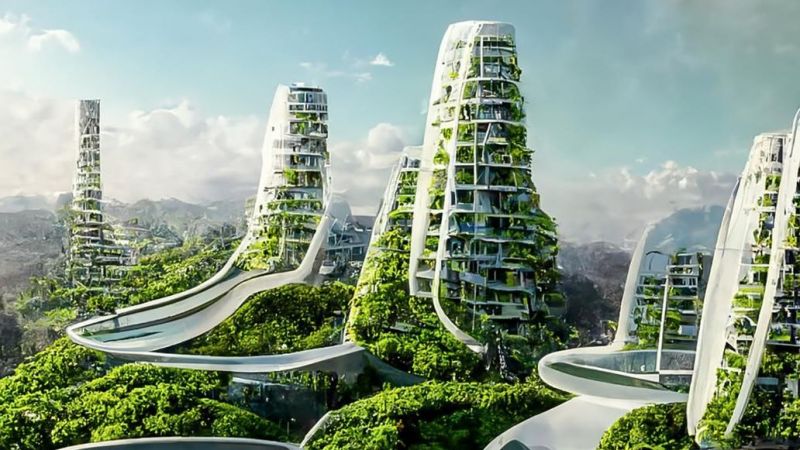
He says he was inspired by Hyperion, a 380-foot redwood in California that is thought to be the world’s tallest living tree. But he has also benefited from his own day-to-day work at Indian architectural firm Ant Studio, which has projects involving retrofitting buildings with new facades to promote natural ventilation and reduce energy consumption.
The idea was for the ‘shell’ of a building to be organic and inspired by nature, so that the towers could regulate their own temperature throughout the day. To be truly organic, we would need to create building materials that could live and grow, and Ventilate the building through these natural processes.
New questions will be asked about popular and industrial integrity in cutting-edge forms of AI content, such as OpenAI’s DALL-E 2 and Google Research’s.
Some social media users and artists have criticized a Colorado game designer for winning $300 at an art competition for a futuristic, Renaissance-style image created using Midjourney. Jason M. Allen’s presentation, which lasted more than 80 hours, qualified as a work of digital art according to the competition’s rules. However, some people have argued that the methods used to create the image do not constitute as art. Allen has defended his win, saying that his presentation was a work of digital art that took many hours to create.
For Bhatia, AI is just another tool that can be used by artists to create art. “Art is completely open to interpretation,” he said. “And an artist can use any tool to create art. Anyone can use AI, but they won’t do as well as a creative person.” he added.
The architect added that users can generate something beyond their imagination, stimulating new ideas and enriching the design process. It even envisions a future where AI can create 3D designs and integrate it into the software architects use to model their creations. “It has tremendous potential,” he said. “In our studio, we tried using AI to create mood board images for a client presentation, and it went very well… In the near future, when architects and designers combine with AI, there will be something to hope for.”