

- Robotics The decade of drones: this is how they will ‘land’ en masse in our cities before 2030
In the 1980s, the Internet had not yet reached our homes, mobile phones did not exist, and computers required entire rooms to provide reasonable computing power. Nevertheless, the science fiction series of the time dared to imagine how the technologies of the following decades would revolutionize the police of the future.
In Fantastic Car we saw an autonomous vehicle that downloaded and analyzed police records, building plans, images from video cameras… He gave them to Michael Knight, a detective for a private foundation who collaborated with law enforcement and who had a watch from which he could give voice commands to his prodigious automobile.
In Robocop we saw an agent who improved his physical and police capabilities by combining his body with an exoskeleton and integrating gadgets such as an augmented reality headset that allows him to superimpose all kinds of information on what he sees, record it, scrutinize it with thermal vision…
blue thunder either the street hawk are other examples of series that imagined how technology could give decisive advantages to upholders of the law over criminals. And they were right. Many of those tools imagined by science fiction have been incorporated into police work in recent years: drones, mobile devices from which to set fines or consult databases…
They are only the beginning of a technological revolution that will completely transform the security forces and bodies throughout the world and for which the ground is already being prepared both nationally and internationally.
Thus, last March Interpol published the working document Scanning the future of the police: the first steps towards a new global paradigmin which the great opportunities and important challenges that will come from the hand of the artificial intelligence, biometric tools, the Internet of Things, the metaverse, drones and smart citiesamong many.
‘WEARABLES’ FOR EVERYTHING
Police will continue to benefit from cutting-edge technology, and it is crucial that they do so or they will be left at a disadvantage compared to criminals, who will always use the latest technology, argues James Slessor, general manager of Accenture’s global Public Safety area and responsible, among others. others, from the report The connected policeman in an era of disruptionanother of those who have delved into this matter in recent years.
Y What will the fight against crime be like in the immediate future? In light of those studies? A quick way to sum it up is to imagine some kind of Robocop connected to the cloud.armed with all kinds of wearables that allow him to physically intervene on the ground, but benefiting in real time from all the information provided by the countless sensors and cameras of the smart citiesas well as the look of consumer devices connected to the Internet of Things.
We will see an increase in the use of wearables that provide agents with information and knowledge to offer the best possible public service and stay safe, confirms Slessor. This will change their appearance and the way they operate and, on a practical level, will allow them to have their hands free and their eyes on the street and involved with the public instead of hanging from a screen, adds this world expert in Public Safety.
As you can see in the graph that accompanies these lines, the list of devices that will gradually be incorporated into police equipment is long: watches with voice recognition, augmented reality or virtual reality glasses to patrol the metaverse or train in real situations; body cameras or cameras integrated into the helmet, facial recognition readers, drones, connected weapons that require the agent’s fingerprint to fire…
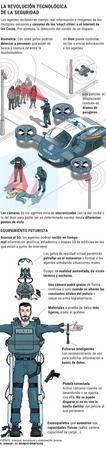
The price of technology is falling rapidly; solutions that were very expensive a few months ago are now quite affordable, in addition to being robust and reliable to be used in a police environment, develops Slessor. In fact, many of these innovations that still sound like science fiction have already been tested in the field.
For example, the National Police presented EHang 216 more than a year ago, its first patrol drone capable of transporting two agents. It is also starting to use facial recognition systems capable of detecting wanted criminals, suspects and other persons of interest.
Disruptive innovations will not cease to be incorporated in the coming years. For example, more and more will be used creating digital twins of a crime scene (or the weapon with which it was committed), so that the investigators of a case can put on virtual reality glasses and review the evidence in the (virtual) field over and over again.
THE CONNECTED POLICE
However, the real change in the police paradigm will not be caused by the part alone. hardware of the revolution, but of the possibility of keeping the agents connected at all times with the part software: the artificial intelligence algorithms that allow to predict crimesthe data analysis techniques that will order and rank huge amounts of information, the interconnection between police databases and evidence extracted massively from social networks…
In fact, the main mission of many of the gadgets incorporated into the uniform will be, precisely, to exchange information with the cloud: the history of a suspect, the route followed by a vehicle, the clues collected by the sensors and chambers of the smart cities Or the Internet of Things…
For example, picking up the sound produced by a gunshot could alert nearby patrols or encourage police officers to quickly send a reconnaissance drone to record a possible crime scene.
All this, interconnected with each other, converted into utility patterns for the agent and instantly downloadable from a squad car, augmented reality headset or voice assistant watch. The data must be one of the main security assets, the extraction of information that can help the Public Security System make decisions or predictive analysis of possible crimes or emergency situations must be a priority and, therefore, it is a clear objective. for the coming years, defends Eladio Alcázar, head of Digital Transformation of Justice and Security Forces at Accenture Spain.
Another of the crucial changes of the new paradigm was also predicted by the series of the 80s. It has to do with the fact that The collaboration of public security agencies with companies such as Accenture itself, Google, Tesla… will be necessary. that can provide them with solutions that are increasingly complex and impossible to develop with their own resources.
But exactly how many years are the experts referring to when they tell us about the police revolution that we will see in the coming years? From a police perspective, the use of new technology requires a long gestation period, as there are many barriers to its adoption, says Madan Oberoi, Interpol’s executive director of Technology and Innovation. Most security technology programs take three to five years to be adopted. due to the need for supervision and ratification, he comments.
The risk of predicting crime with AI
And this, when they do not run into the frontal opposition of the citizenry and its representatives. For example, the European Parliament approved a resolution against the police use of AI a year ago, in which it called for banning facial recognition databases, behavioral predictive techniques and social scoring systems like the one announced by China in 2014.
AI can pose a serious risk to individuals and societies if not used responsiblyaffecting human rights such as privacy and non-discrimination and eroding fundamental principles of the law such as the presumption of innocence, warns Oberoi.
Keep people in the center
A concern that can also be extended to access to all types of data and images by this new connected cyber police officer. Another one that experts often mention is the appearance that it would give them to wear, for example, a graphene exoskeleton that allows them to be invulnerable to bullets or improve their human ability to run, jump or carry a load.
The way in which agents present themselves and operate is important: we don’t want it to take them too far away from the public or look too militarybecause they need to continue to be perceived as people who interact and engage with communities, stresses James Slessor.
We see the agent of the future in a different way than in science fiction, confirms Oberoi. There is an emerging consensus that the future of policing is not just digital, but also based on trust and strong interpersonal skillshe adds.
In fact, the use of chatbot and forms on-line to deal with citizen complaintssolving procedures and collecting complaints, or the preparation of police reports and reports using convenient digital tools, freeing the police from the most routine and low- value tasks.
Their functions will also change substantially. For example, the progressive implementation of autonomous cars that circulate without a driver but programmed to scrupulously comply with traffic regulations will make it necessary less police resources in traffic tasks. Instead, more and more will be required to prosecute crimes in the digital world.
“We’ve seen a big shift towards crime on-line since the pandemic and I think we will continue to see an increase in digital crime,” explains Oberoi, who insists time and time again that the introduction of police technologies will only make sense if it always keeps people at the center: “It could free agents from the most basic tasks and allow them to focus on critical activities,” he adds.
A huge change to achieve that the police are always one step ahead of criminalsbut avoiding that they become what we said that the headline of this report says that they will be: Robocops.