

As with people, there are cars that have received a lot of exposure over the years and others that are unfairly overlooked. The latter, on many occasions, end up receiving the recognition they deserve, either by rediscovering it at some point in history or by having a feature that makes it a special vehicle. One of them may well be Alfa Romeo Alphatta.
The Italian model is not only becoming more sought-after, or driving wonderfully given that it shares some of the drivetrain design with Ferrari, but because its strangely mutated instrument cluster and center console design were years ahead of its time. First of all, let’s give a brief history lesson: the Alfetta in its sedan body was introduced in 1972 and the coupé in 1974, replacing the Giulia (105/115) of the 1960s and early 1970s, and took their name from the successful single-seater Type 159 Alfetta from the 1950s.
Like the racing cars, the Alfetta (yes, even the sedan) had the engine mounted at the front and the gearbox located at the rear to improve weight distribution (the so-called rear configuration). transaxle), a design that ferrari had already adopted 275GTB from 1964 and which it still employs in its current range of front-engined models. However, despite not being as attractive as the Giulia, the series Alfetta GT it looked – and looks – quite graceful, albeit in a different way, like the Lamborghini Miura versus the Countach.
Later, the coupe-bodied Alfetta (which actually dropped the Alfetta name in favor of Fast Sprint and then GTV) got the charmer option V6 “Busso” from Alfa Romeo, but also gained a set of ugly unpainted plastic bumpers. We definitely preferred the look of the first models that landed in dealerships around the world, the ones that came with their twin-overhead-cam four-cylinder engines, slimmer chrome bumpers and a really weird dashboard, especially back then.
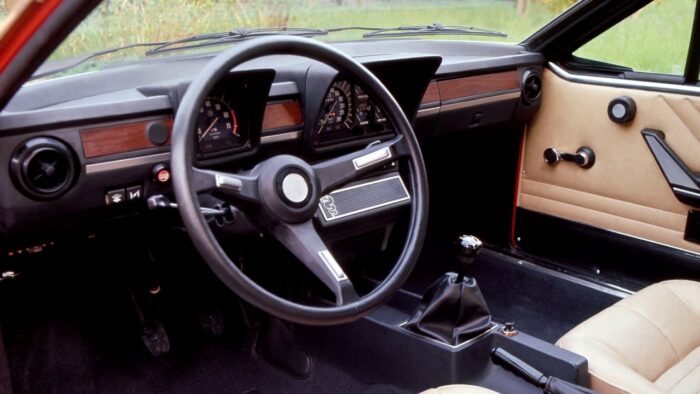
But there is some logic to the weirdness. Being a vintage Alfa Romeo and therefore a true car designed for the most enthusiastic drivers, the only dial in front of the driver is a rev counter. That is all. All the other superfluous things, like the speedometer and fuel gauge, are in the center of the dash in a separate and much larger binnacle. For practical, road-legal driving it’s an ergonomic disaster, and for years many have thought it was pretty dire.
However, looking at the shape and design of those gauge packages, it’s impossible not to see similarities to some of the more modern, electrified vehicles, such as the Volkswagen ID.4 or Polestar 3, or in general any car built in the last decade and equipped with a touch screen of type tablets, like the Citroën C4 Cactus. Even the sliders for the climate control system under the center pod of the Alfa Romeo resemble those of the Volkswagen. Fortunately, these did not have touch-sensitive capability.
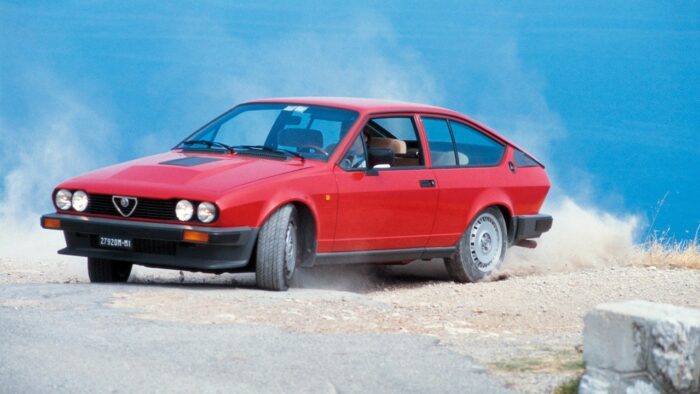
For those who like to tickle the car on a somewhat twisty stretch –always safely– with a manual gearbox, you just need to know at what revolutions you have to change so as not to miss a gear and stay “sold” in the coming out of a curve, or going over laps. And that, currently, is a scarce value. Therefore, whoever looks for it in a classic vehicle has to pay for it. And while an attractive Giulia in years has a market value that does not fall below 50,000 euros, an Alfetta GT/Sprint Veloce/GTV can be found for 10,000 or 15,000 euros.