

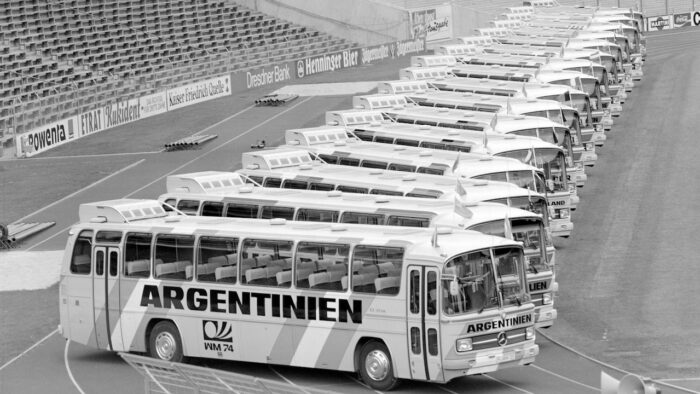
Now that we are facing one of the most atypical World Cups in history due to various factors, we look back to remember other times in the competition. In this case, we travel to the 1974 World Cup, held in West Germany. Although the Federal Republic of Germany would end up winning it in a disputed final against the Netherlands, we are going to leave football on a secondary plane to talk about displacements. Each team received a bus Mercedes-Benz O 302 labeled with their national colors to go to the stadiums.
It was an important vehicle for the brand, so much so that currently the national team is exhibited in the Mercedes-Benz Museum. And it is that with this bus they achieved international visibility in this competition held almost half a century ago. In 1974 sixteen nations participated and they all had their vehicle specially prepared for the occasion. In addition to having the name and colors of the country (like black, red and gold in German), they had all kinds of facilities.
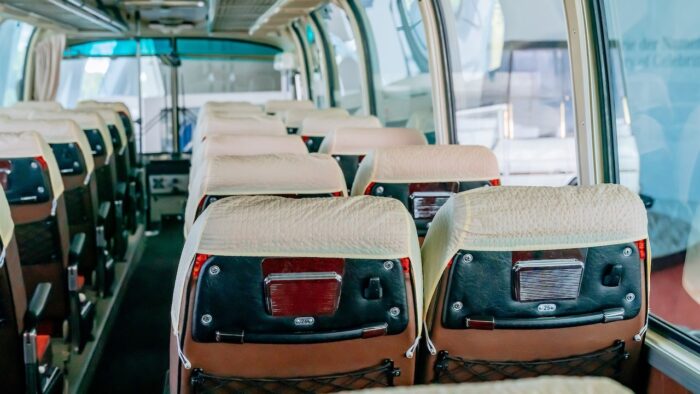
Strangely, each seat had an ashtray and there was a built-in beer tap and bathroom at the back of the bus, clearly they were different times. The seats received a fabric upholstery and had headrest covers, it is even said that each player had their assigned seat (at least in the case of Germany). It was a complete novelty that he was air conditioning availablethanks to a Thermo King system that was located on the roof at the rear and served to cool the hottest moments of the summer of 1974.
Inside they were well equipped so that the players could travel comfortably, while the exterior did not go unnoticed. There were the colors of the country, the logo of the 1974 World Cup and also the mascots. From the back they waved the famous Tip and Tap from West Germany. The Mercedes-Benz O 302 bus had been on the market since 1965 and had been quite successful.
It was available with four naturally aspirated six-cylinder diesel engines with powers between 126 and 240 CV. They also incorporated air suspension from 1971 to improve driving comfort. At the end of their commercial life, in 1976, they had produced more than 32,000 units.