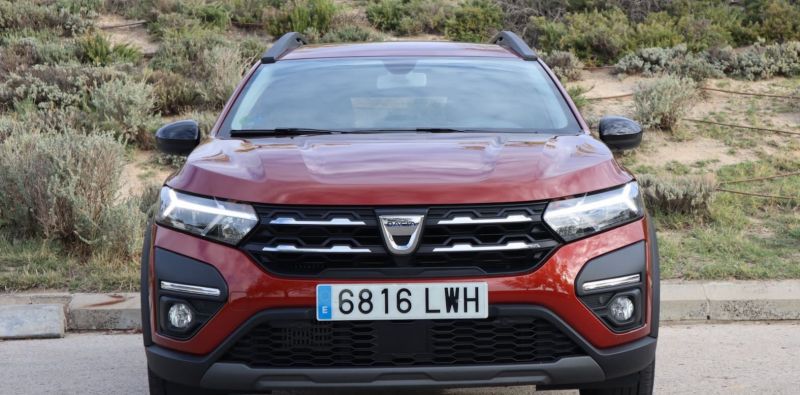

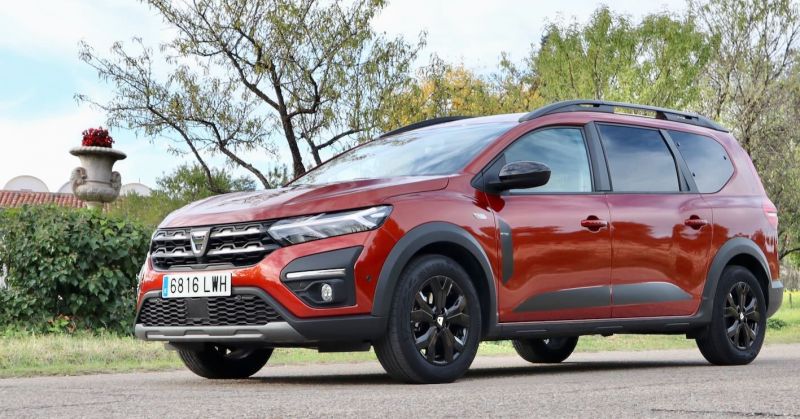
Not too many years ago, you could find cars at prices whose starting price was less than 10,000 euros. The brand that best knew how to explore this access to mobility was undoubtedly Dacia. He fled from playing at being premium, like the vast majority, and focused on offering cheap cars. As the Dacia Jogger what we have here today
Dacia has also been improving its products, and even a Dacia Sandero, the model preferred by individuals throughout Europe, exceeds 12,000 euros. But they are still one of the most interesting products for those looking for a vehicle that can take them anywhere.
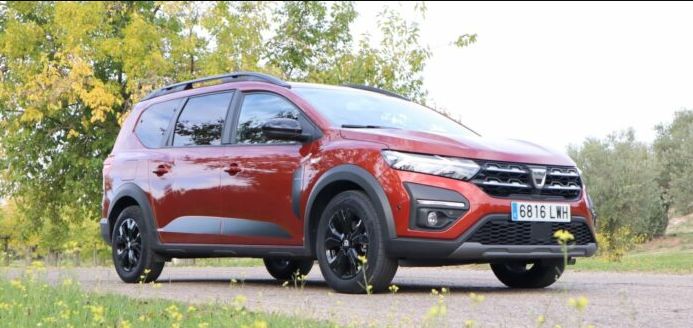
We have found that after driving the Dacia Jogger for a week. It offers a very good interior space, with the possibility of having 7 seats, it is a very versatile car and an excellent price/product ratio.
And it is that the Dacia Jogger has a starting price of €18,650, precisely with this engine, the 1.0 100 CV and transformed to LPG. The figure rises a bit when you choose 7 seats and the Extreme finish, since it goes to 22,400 euros. We always talk about recommended prices, you can find Dacia Jogger offers in our new car section, published by official dealers of the brand. We also have tools to finance the car that help you pay for it more comfortably month by month. But first, it is better that you get to know it in depth to see if it interests you:
Exterior
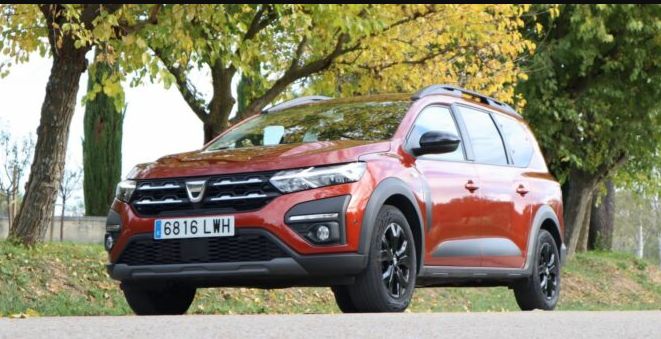
Dacia has wanted to mix concepts, which is something that has worked very well in recent times. We do not know very well if the Jogger is a car with a station wagon, a minivan or even an SUV, because it has details of all of them.
In mid-2022 the brand’s new logo arrived on the Jogger, combining the D and C and a front grill. Those units arrive from October, just when we tested the model. We do see other details such as the Full-LED headlights of the Extreme finish.
For the rest, in the first third, up to the windshield, it is like a Sandero, the model with which it shares a platform. Then on the side things change. You can tell that the rear windows are higher than the front ones, there is a small step.
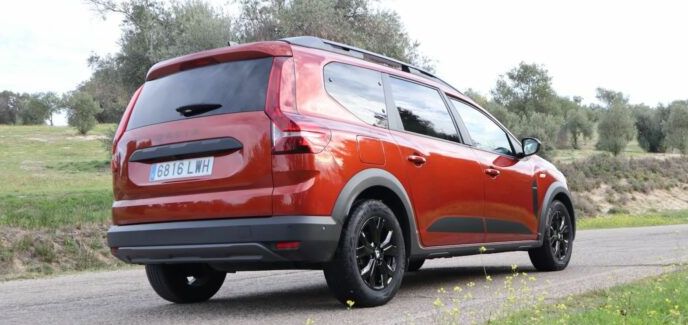
There are also details that show that the brand took care of the design of this car. From 16-inch alloy wheels (with 205/60 tires). Or the side stickers, typical of this finish and give it an air of an SUV. The plastic protections on the underbody visually bring it closer to an SUV and it boasts 200 mm of ground clearance, more than many SUVs. I liked the roof bars, which are very practical since they easily transform into a roof rack and can support up to 80 kg.
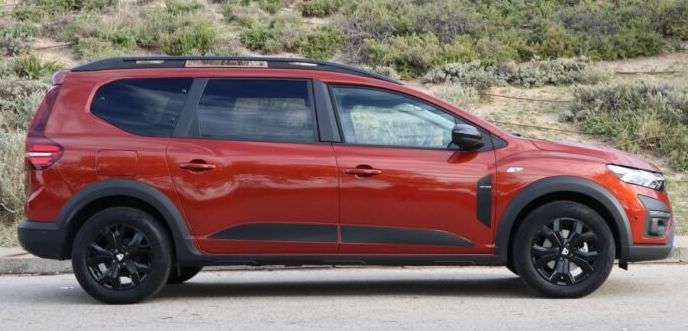
The car is not as big as it seems to the naked eye, as it remains at 4,547 mm in length. It is not very wide either, since it measures 1,784 mm. It does stand out in height, it goes to 1,632 mm, which guarantees a lot of space
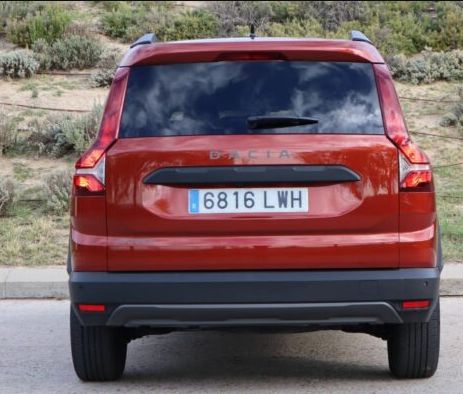
At the rear there are details that denote savings, such as the lights that are not integrated into the tailgate, which falls completely vertically to maximize space.
Inside
The day I got into the Dacia Jogger I had just returned a car for which they ask four times more. If we take that into account, the truth is that the quality of the materials and the finishes are quite good for what they ask for it. No piano black and the textile material that we find on the dashboard or on the doors is quite nice and attractive.
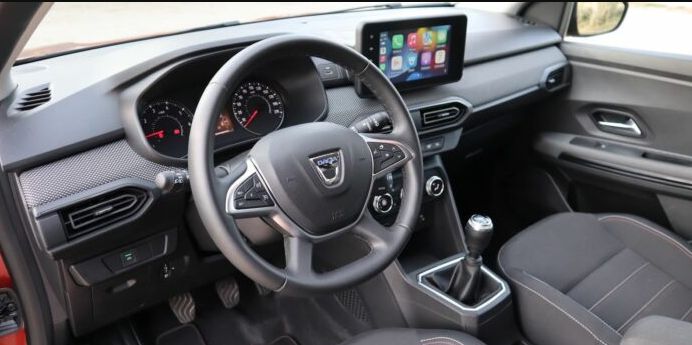
We also found a good habitability but for my taste the seats are not too good for long trips and the pedals are a bit high, so you have to keep your feet quite vertical. The armrest is also somewhat lacking.
For the rest, the arrangement of elements is quite good, traced to that of the Sandero. In the most equipped versions like this we have an 8-inch screen that controls the multimedia system. In the basic ones, there is a mobile phone holder, which you connect to a USB on the dashboard itself. It does not have controls for the volume or the dial, but at least the air conditioning system has not been integrated into it, with independent controls that are very easy to use.
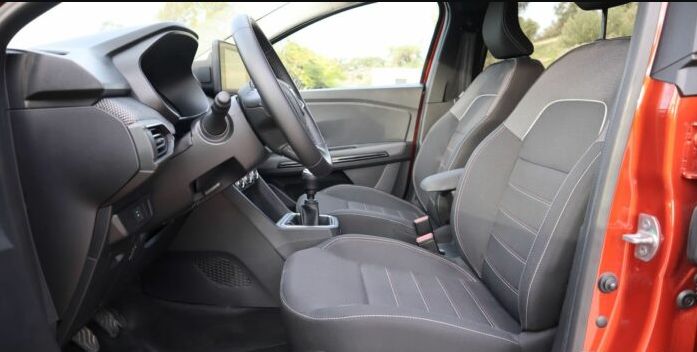
The steering wheel is four-spoke and completely round. It has the right controls, with a satellite, common in Renault, to control the multimedia system. Through it we see a simple instrument panel, with a small screen where the data from the on-board computer is displayed.
The console is quite practical. Dacia talks about 23 liters of storage compartments. There they include from the glove box to door bags. But also the hole under the dashboard, with USB and 12 V sockets or the chest under the central armrest.
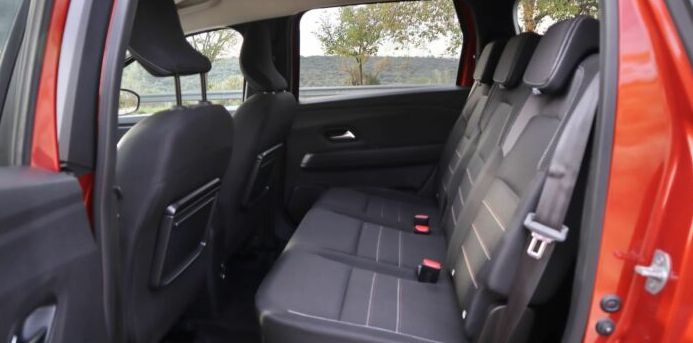
In the second row of seats we find three individual seats (only the ones at the ends with Isofix), which is fine for three people to travel, although they will not be very baggy. The center passenger has a small step in the center, but it doesn’t completely misplace your feet.
One detail, these seats are located 55 mm higher than the front ones, so there is better visibility and it gives you the feeling of going in a higher car than when you are in front. That doesn’t mean there’s plenty of headroom. Of course, there are two details that I did not like at all: that there are no outlets for the air conditioning (a shame in such a large car) and that the seat belt comes out of the roof, which makes its use quite uncomfortable. . With this finish you have trays in the front seatbacks.
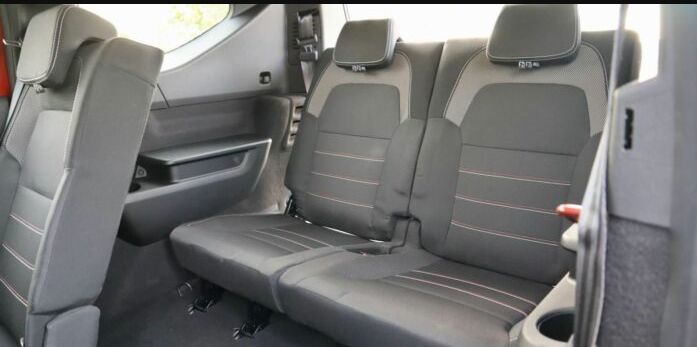
To access the third row of seats, you have to fold the second row bench and then tilt the seat forward. The gap that remains is quite acceptable (the rear doors are very wide) and I admit that the space has surprised me for a car that does not reach 4.6 meters.
They are 25mm higher than the previous row and you have to carry your knees somewhat upright, but two adults can travel on them reasonably well with space. In addition, we have some small armrests, holes to leave objects and compass-type windows, which is always good to ventilate the area.
Trunk
A Dacia Jogger boasts of 708 liter capacity. It is a lot, a figure comparable to that of a small van like the Renault Kangoo. It is the data of the five-seater variant, but we give it to you because the third row seats can be removed, they barely weigh 10 kg each and even if you choose it with 7 seats, you have that space.
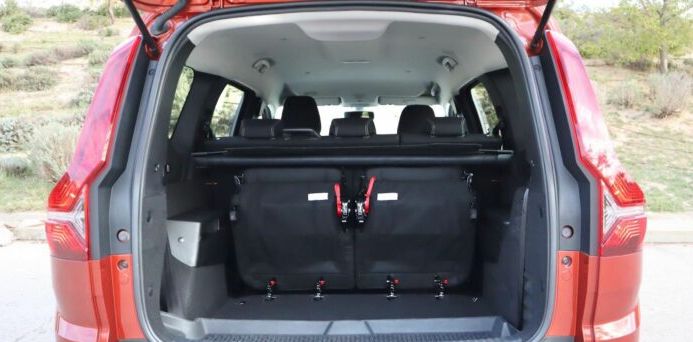
With those additional seats folded, the figure remains at 565 liters, which is a figure equivalent to that of a family compact. When you use them, it stays at 160 liters, forget about long trips with seven occupants.
Model
Length
Trunk
Renault Kangoo Combi
4,486
775
Dacia Jogger
4,547
708 (565)
Kia Ceed Tourer
4,600
625
SsangYong Tivoli Grand
4,480
574
Fiat Type SW
4,571
550
The gate is large and access to the trunk is good. With the rear seats folded down, it does not have very regular shapes and it is a pity that the sunshade can only be used with five seats in use. No more no less. There is also nowhere to store it when we use all the seats.
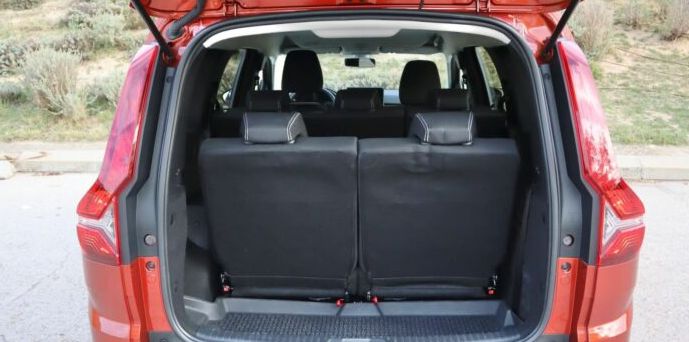
The finishes are those that correspond to a cheap car, but at least we find a 12 V socket, an elastic strap on one side or rings to anchor the load. If you remove the third row of seats and fold down the backrests of the second and raise them, you get a space of 1,819 liters of capacity.
Engine
At the beginning of its commercial life, you can only choose two mechanical options, both based on a block of three gasoline cylinders that other cars in the group mount. On the one hand, the TCe with 100 CV of power and on the other this ECO-G 100 HP and runs on gasoline and LPG. Engines already known and mounted by other Renaults.
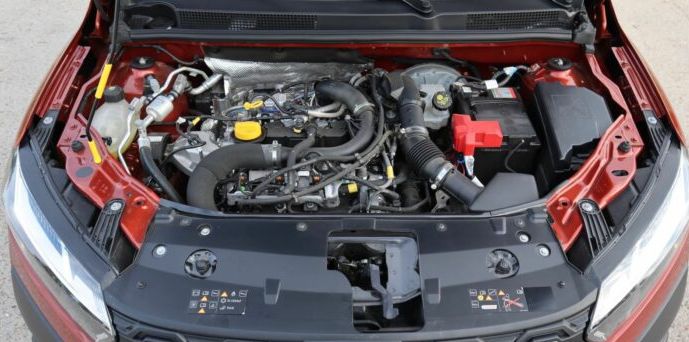
Thanks to this, it obtains the DGT ECO label. It is a turbocharged engine and is associated with a six- speed gearbox. Do not expect great performance, but since it is a fairly light car, it indicates, 1,327 kg that small block manages to take it to 100 km/h from a standstill in 13 seconds and reach a maximum speed of 175 km/h.
It will not be the only mechanical option with an ECO label, since throughout 2023 the range will be completed with the first hybrid in Dacia’s history, a hybrid Jogger with around 140 hp that combines a 1.6-liter gasoline engine with two electric motors, a clutchless transmission and a 1.2 kWh capacity battery. A system that we tested in the Renault Arkana. But while it arrives, let’s see how the bifuel goes.
Behaviour
The truth is that I expected a much rougher car. And not at all. When the engine is running you can hardly hear it and you have to gain speed so that rolling or aerodynamic sound reaches the passenger compartment.
Given the performance data, the truth is that a display of power was not to be expected. Delivers the maximum horsepower quite high, between 4,600 and 500 rpm and its 170 Nm of torque between 2,000 and 3,000 rpm. Of course, it helps to have better performance with the six manual gearbox ratios, better staggered than the five that the Dacia Duster we tested had.
Is it enough to move the car? Well, with little weight, of course, but with seven people or a heavily loaded trunk, it is difficult for him in mountain passes or overtaking. For a lot of traveling I would wait for the hybrid. In the city it does move well and it is quite easy to maneuver with it, but it consumes a lot. We have moved around 10 l /100 km of LPG in urban, somewhat lower, about 8.5 l/100 km on highway and motorway.
Since the cost of LPG is half that of gasoline, it makes you not look at the cost so much. You can choose, with a button to the left of the steering wheel, if you choose one fuel or another. In the chart you can also see how much of both are left. Of course, the start is always in gasoline, because the engine must reach temperature before starting to burn gas.
As it is a car with a good wheelbase, it has good linear stability and poise on fast roads. And without being a car designed to take slow corners at high speed, because it must be recognized that support changes are not his thing, the truth is that the reactions are predictable and that is good. The drum brakes on the rear axle are not too encouraging either, because with the weight they have to support they could heat up faster than usual if you put efforts on it. It is not a car that you ask for brusqueness.
I prefer its comfort, achieved with simple suspensions, independent in the front end and by a torsion bar in the rear, but with a good setting, aided by tires with a fairly high profile, which contain bumps and bumps well.
Opinion cars.com
Without having a knockdown price, the truth is that the Dacia Jogger offers seven seats and a huge boot for a price that no other model comes close. The most similar model, by concept, could be the SsangYong Tivoli Grand, which we also tested and which can be chosen, like this one, with LPG. The Korean is more powerful, and more expensive… but it doesn’t offer all seven seats.
Model
Power
retail price
SsangYong Tivoli Grand
163 hp
€21,900
Dacia Jogger
100 hp
€18,650
Kia Ceed Tourer
120 hp
€23,900
Fiat Type SW
100 hp
€25,350
Renault Kangoo Combi
95 hp
€24,375
Other options are either familiar or derived from commercials. These improve some aspects of the Jogger that have not convinced us. First of all, the consumption, which seemed high to me and at least the transformation to LPG prevents the cost per km from skyrocketing. Some details of the interior have not convinced us either, such as the seats, the belt of the central square. In the mechanical section, we think a slightly more powerful engine would do well… along with rear disc brakes.
Improving those aspects would undoubtedly raise the price of a car that seeks simplicity and consistency. Because, for those 18,650 you can’t find anything better.
Dacia Jogger Extreme 100 CV ECO-G 7 seats