

Lancia is one of the brands with the best track record in competition, moreover, with cars that have become true legends and that are being valued more and more. We review these three unrepeatable icons.
Throughout its long history, Lancia It has left us some of the most beautiful and also revolutionary automobiles. The brand that invented self-supporting chassis, independent suspension, V6 engines or narrow V mechanics seems to have before it a new future after years in a corner. Its new masters seem to be clear that some of its best years had a lot to do with its successes in competition and they use nostalgia to revitalize one of the brands to which automobile fans owe the most. To top it off, this year there are many models that are celebrating their anniversary. The Lancia Lambda celebrates a centurythe Lancia Beta Half a century and the formidable 037 blows out 40 candles, so let’s review these 4 racing legends with the Lancia emblem.
Lancia Fulvia: the basis
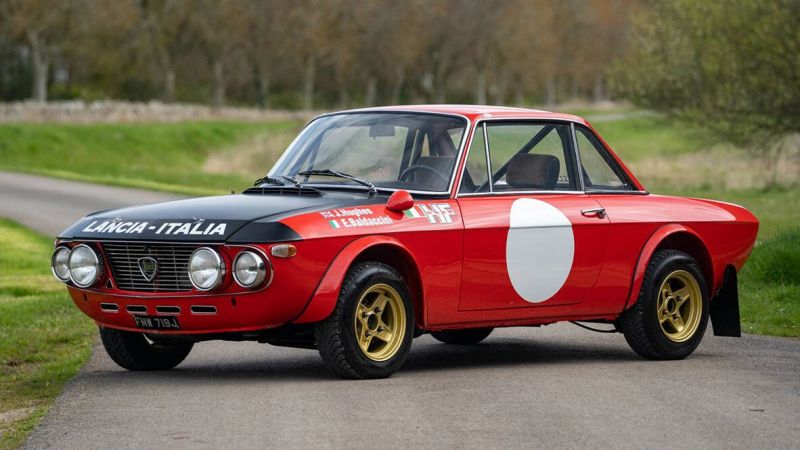 The Lancia Fulvia, thanks to its lightness and good behavior, swept the World Rally Championship.
In 1963 Lancia presented its new medium saloon, the lancia fulviawhich would have a light and agile 2-door coupé version from 1965. In a brand used to breaking the mold, the Fulvia stood out for its technical scheme, with front-wheel drive and revolutionary ultra-compact 4-cylinder engines that allowed a more balanced distribution of weights than inline engines. With the cylinders forming a narrow V, the overall length of the Fulvia’s engine was almost half the usual length and did not require two cylinder heads as was the case with traditional V-engines. Volkswagen would revive this idea years later and even the Bugatti Veyron and Chiron take advantage of this Lancia idea.
The engines available for the Fulvia had various powers, from the basic 1.1 to the powerful 1.6 HF, which reached a respectable 136 CV, a very high figure for an naturally aspirated engine with 2 valves per cylinder and without any type of electronic help for the ignition or injection.
With a weight of less than a ton, the excellent drive provided by having the engine on the drive axle and a very well balanced chassis, the Lancia Fulvia began to make it clear in rallies that it was a very effective tool. In 1972 the Lancia Fulvia became the first Lancia World Rally Champion. Almost at the end of its commercial life, the Fulvia was a car that was beginning to be outdated, so the brand did not fall asleep and, despite its competitiveness and having won the title, they immediately began working hard to replace it.
Lancia Stratos: the first truly professional
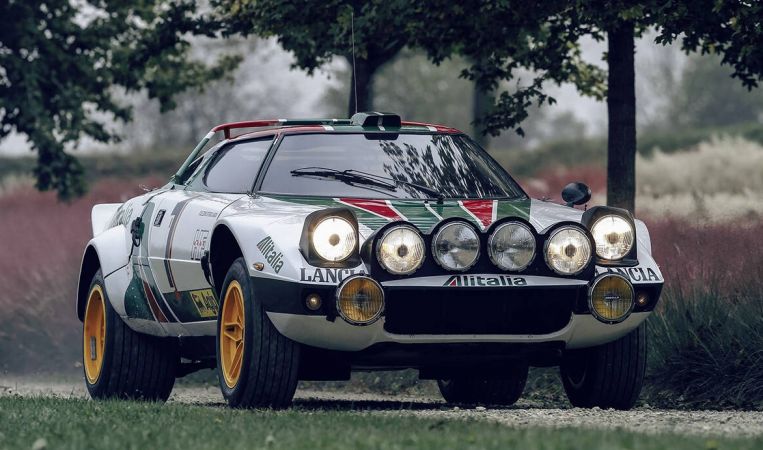
The Stratos looked more like a track car, but it proved to be the best in rallying.
The new World Rally Championship that emerged in the seventies began to make it clear that it was an ideal ground to promote the image of brands. Those local and European championships were unified in a much more demanding, professional and expensive competition. The brands began to bet really hard and the development of the cars evolved a lot. Until the arrival of the Lancia Stratos, racing cars had a lot in common with street models, with minimal improvements. What used to be done was to take a good base like an Alpine A110 or a Ford Escort, boost it, improve the suspension and brakes, lighten it… and run.
Lancia changed the rules of the game in 1972 by introducing the Stratos. Instead of adapting a street car for competition, they designed a competition car that would have street versions. The Stratos was born by and for the competition. Its bodywork, inspired by the Stratos Zero concept that Gandini had designed for Bertone, was designed to be aerodynamic and allow the most comfortable access possible to the mechanics. The front and rear hoods completely expose the innards of the Stratos, so in-race repairs were greatly simplified.
The engine chosen to power the new model was the V6 developed by Ferrari for the Dinoa light, very compact engine (which allowed it to be mounted in a transverse rear position, as the Lamborghini Miura had become fashionable) and with a high specific power.
With a very short wheelbase to make it more manageable in twisty areas, excellent driveability with the engine mounted on the axle and an excellent power-to-weight ratio, the Lancia Stratos seemed out of place on dirt tracks, in African mudflats or in the snowy sections. Its sharp silhouette and V6 bellow were more befitting of a tarmac track than car-wrecker competition, but the Stratos made it immediately clear that it was built to be the best at what it did…and it was.
In the 74, 75 and 76 seasons there was no way to get out of the drawer to the Lancia Stratos and even the year in which Fiat took action on the matter and forced its withdrawal to promote the Abarth 131the Stratos got the drivers’ title for Sandro Munari in ’77. It was clear that if Fiat hadn’t decided to retire the Stratos, it would have remained the champion for several more seasons… it was born for it.
Lancia 037: the essence
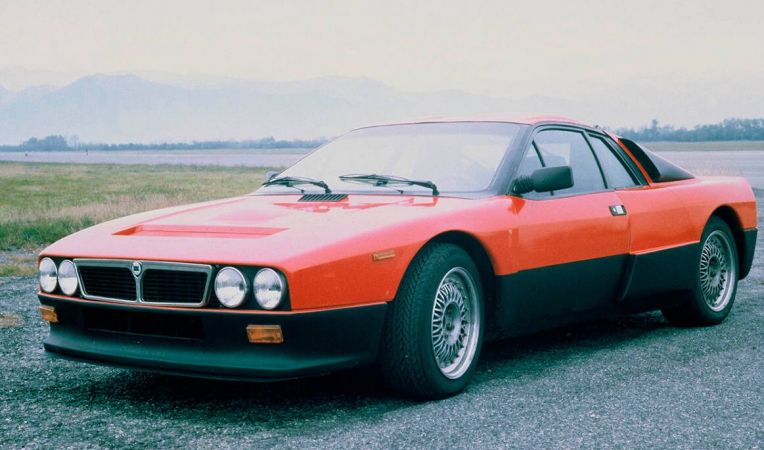
The evolution carried out by Abarth on the Montecarlo was impressive.
Just ten years after the launch of the Lancia Stratos, Abarth evolved the concept of the Lancia Beta Montecarlo to the maximum. It widened its tracks, placed the engine longitudinally instead of across, modified the front and rear to, as in the Stratos, leave convenient access to the tubular subframes that held the mechanical organs and boosted the engine with supercharging. This is how the Lancia 037 was born, another myth of the competition created with a single purpose: to humiliate the competition.
Light, with perfect dynamic behavior and unusual precision, the Lancia 037 had a design perhaps less spectacular than that of the Stratos with its retractable headlights, but its silhouette was very slim and fooled no one. He was a wolf in wolf’s clothing.
This new Lancia car was born at a time when a new technology changed the rules of the Championship forever, all-wheel drive which, after years of being banned, had been conveniently approved to the luck of Audi, who knew how to exploit it at the best moment. Nevertheless, the Lancia 037 took the title in 1983a milestone that has not been repeated since it is the only two-wheel drive car that has been able to win a world championship against all-wheel drive cars.
Lancia was clear that to stay on top it had to evolve its cars and add this new technology, at a time when all brands saw how Rallys were the best showcase to promote their image. Peugeot, Lancia, Audi… even Porsche and Ferrari wanted to enter fully into this new mass phenomenon… but the fatal accidents of some beasts that almost rivaled the Formula 1 of the time imposed changes in the regulations, Group B disappeared and a new premier class would emerge.
Lancia Delta: at the top
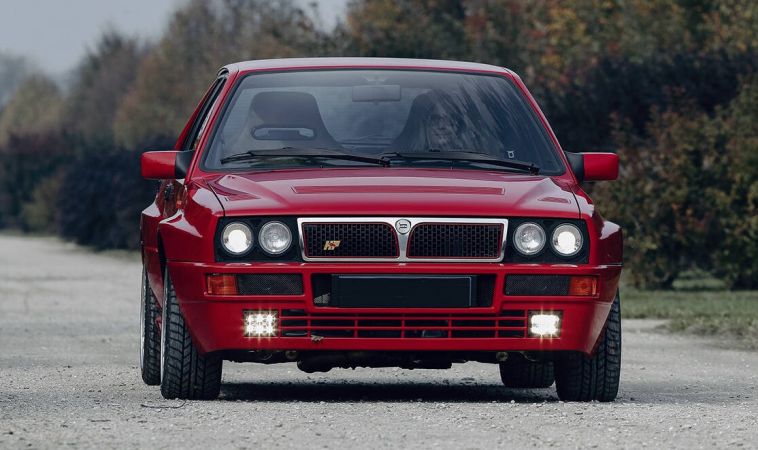
The Lancia Delta Integrale has the best record.
With Lancia’s experience in competition, what they learned with the Delta S4 while the Group B existed and the perfect mule that was the Lancia Beta Trevi for the development of all-wheel drive, the Lancia Delta HF 4WD was born in 1988. His supremacy in that season was remarkable, but no one imagined that he could stay at the top for as many years as he did.
For six consecutive seasons the Lancia Delta was the World Champion, a feat unmatched by any other car to date. Efficient and fast like no other rival, the Lancia Delta Integrale became a symbol and led Lancia to the most popular years of the brand in its history. The Lancia Delta was so legendary that it even eclipsed its own brand and became an irreplaceable model. In 1992 the laurels were over for the Delta, a car that had already been on the market for 12 years. It was time for a relay, but how could you do better than the six-time world champion car?
The second generation of the Lancia Delta presented in 1993 had the difficult role of living in the shadow of its predecessor and without a clear direction the brand began to abruptly lose the glory it had achieved. The competition had propelled her to the heights of popularity, and leaving that world so bluntly took its toll on her.
Between these 4 models they add up to no less than 17 world titles for brands and pilotsa feat that has not been achieved by any other mark on the extremely tough terrain of the World Rally Championship.