

Ferrari introduced to Ferrari 499Pof the hypercar with which the Italian brand intends to fight in 2023 for the glory of the main category of the WEC and, obviously, for the absolute victory in the mythical 24 Hours of Le Mans.
This name evokes the history of the Prancing Horse manufacturer in endurance racing. In the past, prototypes were identified by the letter “P”, often preceded by the unit displacement number of the engine. The 499P is no exception.
The car is the result of a vision proudly rooted in the past that gave rise to the legend of today, allowing the company to achieve 22 world titles and nine overall wins at Le Mans. However, he has his sights set on the future, both in terms of the technical content and the design that the prototype presents.
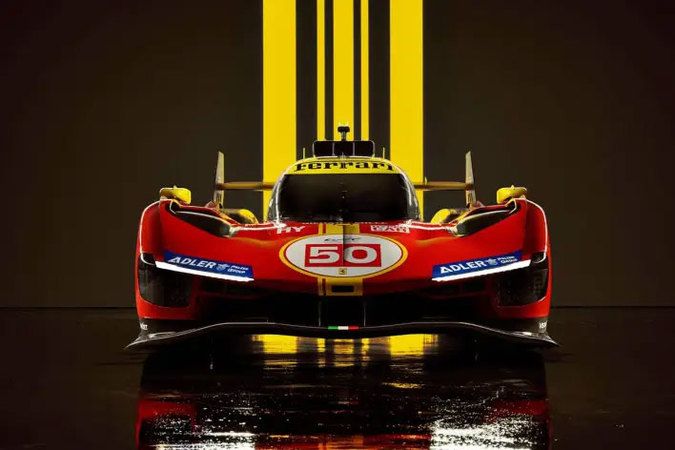
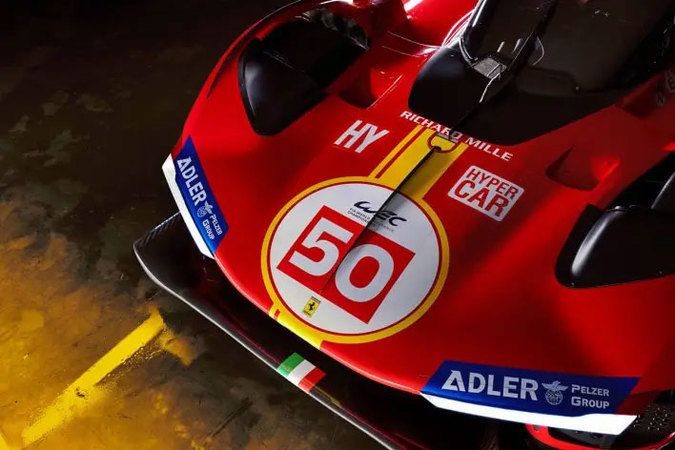
The livery with which the 499P will debut in the next 1,000 Miles of Sebring includes a version of the famous 312 P color scheme from the 1970s to visually underline the historical connection to Ferrari’s last work 50 years ago.
For this reason, one of the endurance cars entered in Maranello will be adorned with the number 50, while the other will carry 51, one of the most successful race numbers in its history. The official line-up of those who will run with the 499P will be the subject of future communications.
“With the 499P we compete again for the absolute victory in the WEC series. When we decided to commit to this project, we embarked on a path of innovation and development, true to our tradition that sees the track as the ideal terrain to push the limits of cutting-edge technological solutions, solutions that will eventually be transferred to our cars. of road”, he claimed John ElkannExecutive Chairman of Ferrari.
Ferrari 499P, with winning DNA
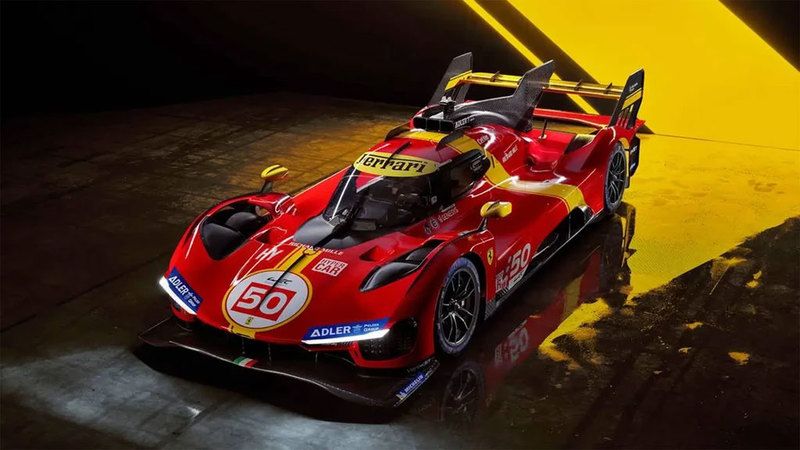
The new technical regulations of the FIA and the Automobile Club de l’Ouest for the Hypercar category have led Ferrari to embark on a path of innovation and development to produce a Le Mans Hypercar (LMH) faithful to tradition, which sees the circuit as the ideal terrain to develop cutting-edge technological solutions that are integrated into its road cars. The 499P is a manifesto of Ferrari’s commitment to endurance racing.
The prototype with Four-wheel drive complies with the technical regulations and the requirements of the Le Mans Hypercar category with hybrid enginedelivering a maximum power of 500kW to the wheels and with a minimum weight of no less than 1,030 kilos.
To define the 499P, the company has drawn on the extensive resources of technical, professional and human excellence that characterize the Maranello brand, entrusting the management to Attività Sportive GTunder the direction of Antonello Coletta and the technical supervision of Ferdinand Cannizzohead of the department in charge of the engineering and development of sports and GT racing cars.
New hybrid power
The 499P’s hybrid powertrain combines a power unit at the rear with an electric motor driving the front axle. The internal combustion engine (ICE) has a maximum power limited by regulations to the wheels of 500 kW (680 hp) and is derived from the V6 biturbo road family.
The ICE, which shares the architecture of the engine fitted to the 296 GT3, has been the subject of a thorough review by Ferrari engineers, aimed both at developing ad hoc solutions for the prototype and at lightening the overall weight.
Among the specific features of the 499P V6 is the fact that the engine is load-bearing and therefore fulfills a valuable structural function, compared to versions fitted to GT racing cars, where the engine is mounted in the rear subframe of the car.
The second “soul” of the hybrid powertrain is the Energy Recovery System (ERS) with a maximum power of 200 kW (272 hp). The electric motor is equipped with a differential and is powered by a battery that recharges during deceleration and braking, without the need for an external power source. The battery pack, with a nominal voltage of 900v, benefits from the experience gained in the Formula 1, although it has been built specifically for this project. Total peak power of the 499P is 500 kW (680 hp) and the drivetrain is mated to a seven-speed sequential gearbox.
Designed by the wind
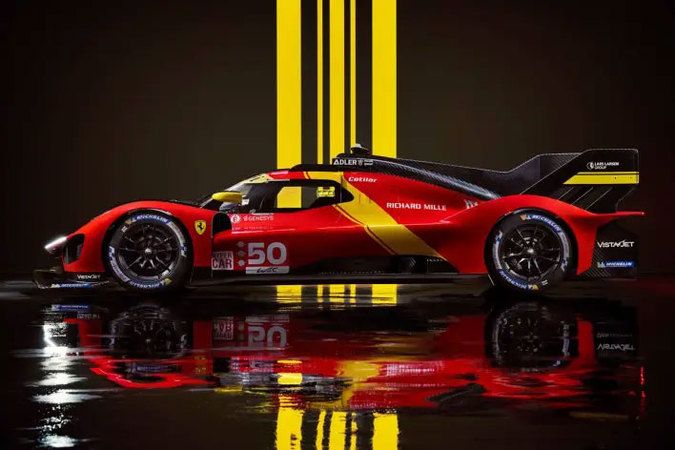
The design of the new Ferrari 499P has been perfected with the support of the Ferrari Styling Center under the direction of Flavio Manzon. The technical and aerodynamic characteristics of the car have been enhanced by simple and sinuous shapes, an explicit expression of Ferrari’s DNA.
The balance between taut lines and flowing surfaces, expressed in a futuristic, pure and iconic language, defines a clear but essential architecture. The body of the prototype is sculpted from a flat surface, from which the side pods and wheel arches develop harmoniously. The aerodynamic flows through the side pods over the gaps between the main ridges that surround the cabin, cooling the radiators hidden under the bodywork.
On the Ferrari 499P, the surface of the wheel arches, a Ferrari hallmark, is characterized by large grilles, designed to reduce the pressure inside the wheel wells. Together with the headlight clusters, they give the front end a sense of character and expressiveness, with subtle references to styling cues first introduced on the Ferrari Daytona SP3.
The rear is the maximum expression of how to combine technology, aerodynamics and design. A subtle carbon fiber skin covers the various functions, leaving the wheels and suspension fully visible. The tail is characterized by a double horizontal fin; the main wing and upper flaps have been meticulously designed to ensure the necessary downforce for maximum performance.
The lower spoiler it also features a “light bar” that enriches the rear design with a decisive yet minimalist touch. Finally, commanding a commanding position above the car is an air intake manifold that feeds the V6 engine’s intake and supplies cooling air to the battery and gearbox.
innovative technologies
Built on a all-new carbon fiber monocoque chassis, the Ferrari 499P features solutions that represent the cutting edge of motorsport technology. The double wishbone suspension geometry, a push-rod type, results in extraordinary damping stiffness qualities, the benefits of which are evident both at top speed and when cornering. The electronic systems have been developed from the experience gained in the world of GT racing and have further innovated.
No less sophisticated is the break system, which integrates a brake-by-wire system necessary to allow the recovery of kinetic energy by the front electric axle when braking. The system has been developed to combine precision and responsiveness with reliability and durability, complementary aspects that are one of the keys to success in endurance racing.
The electric front axle uses the energy recovered during braking, storing it in the high-voltage battery before transmitting torque to the front wheels when a certain speed is reached, thus helping to improve performance on the circuits planned for the 2023 calendar. .