

The use of dummies for crash tests was born in the 70s, when General Motors created the Hybrid I, a dummy designed to represent the average man in height, weight and proportions. It was a time when driving was considered to be a predominantly male activity, something that has changed a lot today.
Over time, when mannequins were needed to represent women, children and babies, the engineers simply changed the size of the male mannequininstead of creating models that follow the average shapes and proportions of other human genders and ages.
It was only in 2011 that the first crash test focused on female physiognomy was carried out, but their complexion represented only 5% of women, measuring 1.50 m and weighing 49 Kg, the approximate dimensions of a 12-year-old girl. Even today, it is still the only way to represent another body.
But this is about to change, as BBC News reports, a research team in Sweden has finally created a mannequin to correct this space that has been empty for decades, by creating a mannequin with more realistic proportions.
The new mannequin measures 1.60 m and weighs 62 Kg, which are much more representative measurements for an average female body. And beyond these figures, the important thing is that the chest and hips of the new test dummy better represent the shapes of the average woman as well as her biomechanicswhich in general terms has less muscle mass and strength compared to the average male body, but much greater flexibility.
Why is it so important to implement female dummies in crash tests?
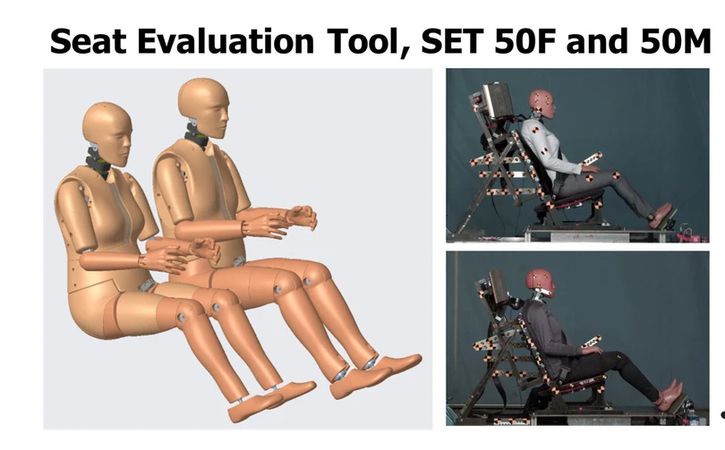
According to information from the NHTSA, women are 73% more likely than men to be seriously injured in a car accident. Astrid Linder, an engineer and director of road safety at the Swedish National Road and Transport Research Institute, led the research team behind the new dummy. She said that the aspect of stiffness is especially important because women are more at risk of whiplash in low severity crashes than men.
According to their research, quite different results are obtained from different seats depending on whether it was the man or the woman who was occupying them. Besides that, a properly proportioned dummy provides better data on air bag crashes with women and how seat belts work on different hip shapes with more flexible joints.
The creation of this new test dummy needs to be studied and regulated by the relevant security agencies so that it becomes a standard in the industry. Its use in the real world will depend on political and business will.