

The north of Chile was the stage to test two experimental units of the Porsche 911who was prepared to do things that normally a nine-eleven would not do, was able to climb the steep slopes of Ojos del Salado, the highest volcano in the world.
These two experimental units of the 911 were tested “where there are no roads, where the air is scarce, where the temperature is well below freezing and even where plant life does not exist”, indicates the brand. Typical conditions of the foothills of northern Chile.
.jpg)
The team was led by endurance pilot Romain Dumas, and the goal was to take the 911 to an altitude where it had never been before. Finally, the team stopped at 6,007 meters, with the 911 overcoming steep slopes and ice zones, temperatures of 30 degrees below zero and with half the oxygen in the air than at sea level.
“It has been a memorable and special adventure, in a place as beautiful as it is brutal. I guess today the only machines in the whole world higher than ours were airplanes! For the team it was all about learning and from the get go the car has been seen to be tough and agile. We were very demanding and we made the most of it from the beginning, but it behaved as if it were at home”, comments Romain Dumas, 911 driver and team leader.
.jpg)
“Despite the massive amount of ice and snow on top of the volcano, we climbed to over 6,000 meters, to the point where the icy walls prevented us from going any further. We are very proud of what the 911 has been able to do.” achieve for the first time, hopefully we will have the opportunity to face many more adventures in the future”.
The experimental Porsche 911
The brand took a 911 Carrera 4S (992) as a base, keeping the standard turbocharged six-cylinder boxer engine, which develops 450 Hp, coupled with a seven-speed manual gearbox, although with new shorter gear ratios.
.jpg)
From there, the engineers at the Porsche Research and Development Center in Weissach, in close collaboration with Romain Dumas Motorsport, unleashed their creativity to prepare the 911 for the specific demands of the mountains.
The two units were equipped with anti-roll bars, carbon fiber seats and harnesses, to meet the safety requirements that a project demands. Portal axles were added to increase ground clearance (now 350mm), and large all-terrain tires. In addition, they were equipped with a special underbody protection made of aramid fiber, a light but extremely resistant material that slips on rocks.
A device called the Porsche Warp-Connecter was also added, which allows a mechanical link between all four wheels to allow a constant load on them, even when they are at the extreme ends of suspension travel. This makes maximum traction capacity possible.
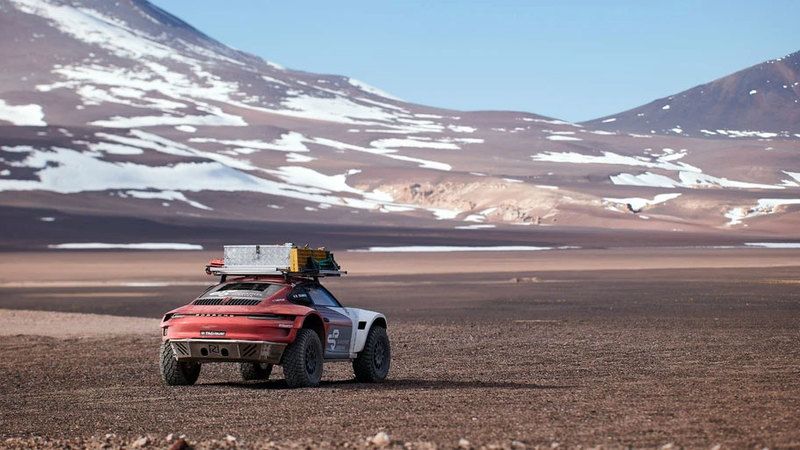
Manual and interchangeable differential locks were used, along with an advanced steering-by-wiresystem. Lastly, a winch was added to the front, on redesigned bodywork to allow for wheel clearance and 310mm wide off-road tyres. The cooling system also had to be moved up to allow the car to tackle the roughest sections without damage.
As a final touch, the bodywork was finished with two distinctive liveries: one in the same Porsche Motorsport color scheme that adorns the 963 LMDh, and a second with a 911 theme by the Weissach design team.